Imagine strolling along Marbella’s beautiful paseo, the sea breeze on your face, without a second thought about a misplaced step or an uneven paving stone. For too many, that simple pleasure has become a source of quiet anxiety. It’s completely understandable to feel your world shrinking when confidence in your own stability begins to waver; the fear of a fall can be more limiting than any physical challenge, keeping you from the active, sun-filled life you cherish.
But you can regain that sense of control and freedom. This guide is here to empower you with safe, effective balance exercises for elderly Marbella residents, designed to build not just physical steadiness but profound confidence in your every move. You’ll discover simple, physiotherapist-approved movements to practise at home and learn how mastering your breathing can become your most powerful tool for staying active and independent.
Key Takeaways
-
Learn the surprising connection between your breathing and your stability, and how improving your breath control can directly enhance your balance.
-
Discover five simple and safe balance exercises for elderly Marbella residents that you can practise at home to build strength and confidence.
-
Receive practical tips for making your home safer and choosing the right footwear to navigate Marbella’s cobbled streets and beaches securely.
-
Understand how a personalised assessment combining respiratory and falls prevention expertise can help you regain your independence.
Table of Contents
Why Balance Exercises are Essential for Seniors in Marbella
Your ability to balance is not something you are simply born with; it’s a dynamic physiological skill that your body must constantly practise and refine. Think of it less as a fixed state and more as a muscle. If you don’t use it, you begin to lose it. This process involves a remarkable partnership between your brain, your inner ear, your eyes, and sensory receptors in your muscles and joints. This intricate human balance system works tirelessly to keep you upright, but as we age, its efficiency can naturally decline unless we actively work to maintain it.
For those of us living in Marbella, the environment itself presents unique challenges. The very features that give our town its charm can also test our stability. A stroll through the beautiful but uneven cobblestone streets of the Old Town, or a walk along the soft, shifting sands of Playa de la Fontanilla, requires a higher level of balance control than navigating a flat, predictable surface. Without a strong sense of stability, these simple pleasures can become sources of anxiety.
The Local Context: Staying Active on the Costa del Sol
Maintaining good balance is the key to unlocking the vibrant outdoor and social culture that makes Marbella so special. It’s the confidence to meet friends for a coffee in the Plaza de los Naranjos, the stability to enjoy a round of golf, and the freedom to walk the Paseo Marítimo without fear. Feeling steady on your feet isn’t just a physical benefit; it’s a psychological one, empowering you to remain an active and engaged member of the community.
A fall can do more than cause a physical injury. It can shatter confidence and disrupt the active retirement you’ve worked so hard to enjoy. The fear of falling again can lead to a reduction in activity, which in turn weakens muscles and ironically increases the risk of another fall. This is why we focus on proactive "pre-habilitation". By engaging in specific balance exercises for elderly Marbella residents, you are building a physical defence against common injuries like hip fractures, allowing you to protect your long-term independence and quality of life.
Understanding the Statistics of Falls in the Elderly
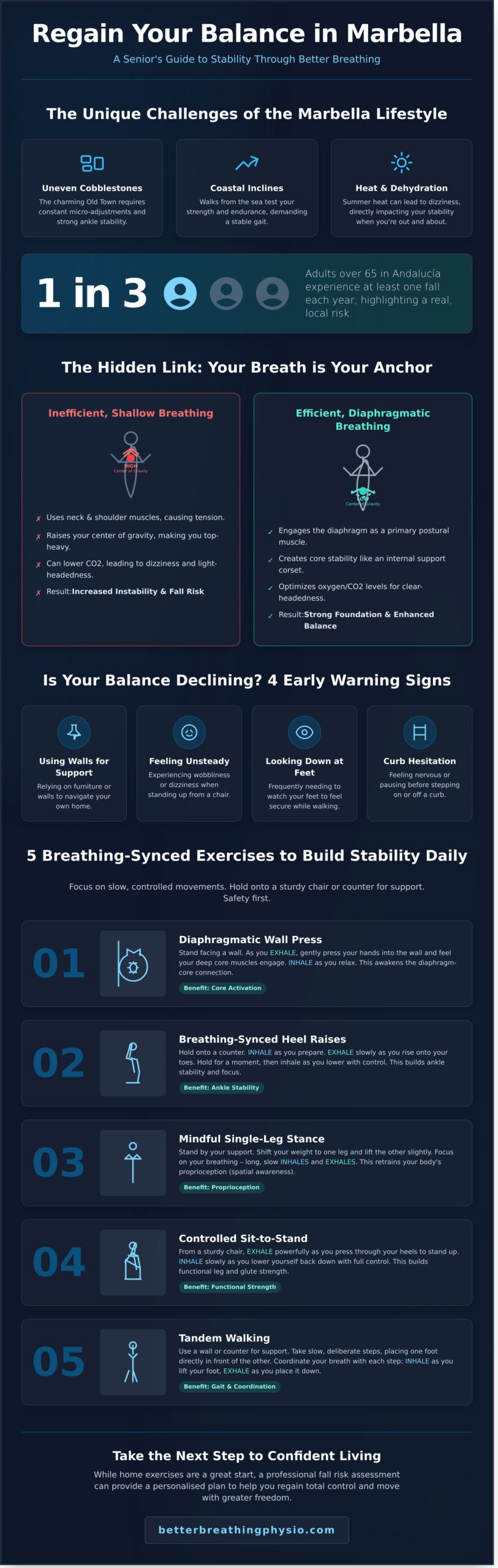
The numbers highlight the importance of taking action. According to the World Health Organisation, approximately 1 in 3 adults over the age of 65 will experience at least one fall per year. A single incident can trigger a debilitating cycle of fear and inactivity. This is why early, evidence-based intervention is so critical. You have the power to step out of this cycle before it begins, transforming vulnerability into resilience through targeted, consistent practice.
The Surprising Link Between Breathing and Better Balance
When you feel unsteady on your feet, your first instinct might be to focus on strengthening your legs. While strong legs are certainly important, they are only one part of the stability equation. The true foundation of your balance doesn’t begin in your feet or your legs; it starts with your breath. This connection is often overlooked, yet it’s one of the most powerful tools we have to improve stability and reduce the risk of falls.
Your diaphragm is a remarkable muscle. Most people know it as the primary muscle for breathing, but it also serves a crucial second role as a major postural stabiliser for your core. When you take a deep, diaphragmatic breath, it contracts and flattens, increasing pressure within your abdominal cavity. This pressure creates a firm, stable cylinder around your spine, acting like a natural corset. This "Core-Breath Connection" provides a solid base from which your arms and legs can move with confidence and control. Without this stable trunk, your limbs are trying to operate from an unsteady platform.
The link becomes painfully clear when you experience breathlessness, or dyspnoea. Your body’s primary directive is survival, and breathing is non-negotiable. When you struggle for air, your brain diverts all its resources to the task of respiration, leaving fewer resources for postural control. Studies have shown that even mild dyspnoea can increase postural sway by over 20%, making you feel significantly less stable. This is why effective balance exercises for elderly Marbella residents must begin with an assessment of breathing patterns. It’s not just about leg day at the gym; it’s about re-establishing the very pillar that holds you upright. The American Heart Association rightly includes essential balance exercises as one of the four key types of physical activity, and mastering your breath is the secret to performing them safely and effectively.
How Respiratory Conditions Affect Your Centre of Gravity
For individuals with conditions like COPD or asthma, chronic breathlessness forces the body into inefficient "chest breathing" patterns. This pattern relies on the smaller muscles in your neck and shoulders, causing them to tense up. This constant upward pull physically raises your body’s centre of gravity, making you more top-heavy and inherently less stable. Your body is then forced to expend precious energy just to stay upright, even before you take a single step.
Respiratory Muscle Training (RMT) as a Balance Tool
This is where we can intervene proactively. By strengthening your respiratory muscles, you create a more robust and reliable foundation for all movement. Better, more efficient breathing improves oxygenation, which in turn enhances the cognitive function and focus you need to navigate your surroundings safely. When your brain isn’t preoccupied with the struggle for air, it can better concentrate on coordination and movement. Respiratory Muscle Training is a targeted clinical intervention using specific devices to strengthen the muscles of inspiration and expiration, thereby enhancing core stability and postural control.
By shifting the focus from just your legs to the very engine of your body, you can achieve a deeper, more resilient sense of stability. Understanding how to harness your breath is the first step towards regaining control. Discovering your current respiratory strength is simple, and our specialised physiotherapy assessments can provide a clear starting point on your journey to better balance and breathing.
5 Essential Balance Exercises for Seniors to Practice at Home
Regaining control over your stability begins with creating a safe and supportive environment. Before you start, ensure you have a sturdy chair or a kitchen counter nearby for support. Your safety is the priority. Remember, consistency is far more powerful than intensity. A dedicated 10-minute daily practice will yield far greater results than one strenuous hour per week. We also encourage you to try these exercises barefoot on a non-slip surface. This enhances proprioception, the crucial feedback loop between the soles of your feet and your brain, helping your body to better understand its position in space.
The Exercises: Step-by-Step Instructions
These five movements are designed to build functional strength and stability, directly translating to more confidence in your daily life. Focus on controlled movements and steady breathing throughout.
-
1. Single-Leg Stance: This is the foundation of walking. Stand behind your support, holding on with both hands. Shift your weight onto your right leg and slowly lift your left foot off the floor. Keep your posture tall and your gaze fixed on a point in front of you. Aim to hold for 15-20 seconds. Lower your foot and repeat 5 times on each leg. Progression: As you feel steadier, progress to holding on with one hand, then one finger, and eventually, no hands at all.
-
2. Heel-to-Toe Walk (Tandem Walking): This exercise improves your ability to navigate narrow spaces. Stand alongside a wall or counter for light support. Place the heel of one foot directly in front of the toes of the other, as if walking on a tightrope. Take 10 slow, deliberate steps forward. Progression: Try to take a few steps without touching the wall for support.
-
3. Sit-to-Stand: Functional power is essential for independence. Sit tall on the edge of a sturdy chair, with your feet flat on the floor. Cross your arms over your chest. Lean forward slightly and, using the power of your legs and core, push yourself up to a full standing position. Then, slowly and with control, lower yourself back down. Aim for a set of 8-12 repetitions. Progression: Slow the movement down, taking 3 seconds to stand and 3 seconds to sit.
-
4. Side Leg Raises: Lateral (sideways) falls are common, and this exercise strengthens the hip abductor muscles that prevent them. Stand holding your support. Keeping your body tall and straight, slowly lift one leg out to the side without leaning your torso. Hold for 2 seconds and lower with control. Complete 10-15 repetitions on each side. Progression: Add a light resistance band around your ankles to increase the challenge.
-
5. The "Breathe-and-Balance" Drill: This integrates our core principle: better breathing for a better life. Stand in a comfortable position, holding your support. Take a slow, deep diaphragmatic breath in through your nose for 4 seconds, feeling your abdomen expand. As you exhale slowly through your mouth for 6 seconds, focus on keeping your body perfectly still. This simple act calms the nervous system and anchors your stability. Practise for one minute. This is one of the most vital balance exercises for elderly Marbella residents we teach. Progression: Try this while performing the Single-Leg Stance.
When and How Often to Practise
The key to building lasting stability is the "little and often" approach. Integrating these movements into your daily routine makes them feel less like a chore and more like a natural part of your day. You could practise your Single-Leg Stances while the kettle boils or do a set of Sit-to-Stands during a television advert break. A consistent 10 minutes each day is the goal.
You’ll know you are getting steadier when you can increase your hold times or reduce your reliance on support. Perhaps you started by holding a stance for 10 seconds and can now comfortably hold it for 30. Or maybe you can now complete the Heel-to-Toe walk without touching the wall. These are clear, measurable signs that your body is adapting and your confidence is growing. Keep a small log to track these improvements; it’s a wonderful source of motivation.
Safety First: Navigating Marbella and Your Home Safely
Mastering new movements is only one part of the equation. The true goal of any programme of balance exercises is to build the confidence to move freely and safely through your daily life. This means taking a clear, honest look at your environment, both inside your home and out in our beautiful city, to identify and mitigate potential risks before they become problems.
Many traditional Andalusian homes, with their beautiful but often slippery terracotta or marble tiles, present unique challenges. A simple spillage or a freshly polished floor can transform a familiar space into a hazard. Decorative rugs, or alfombras, can easily slide on these surfaces. We recommend securing them with high-quality non-slip underlays or, in high-traffic areas, removing them entirely. Also, be mindful of subtle changes in floor level between rooms, a common feature in older properties. A strip of high-contrast tape can make these small steps much more visible.
Your choice of footwear is crucial. While the Marbella climate encourages sandals, flimsy flip-flops or backless shoes offer almost no support and can easily lead to a trip. Instead, opt for footwear with:
-
A sturdy, non-slip sole.
-
Good arch support to maintain foot alignment.
-
A secure heel strap to prevent your foot from sliding.
Managing the Costa del Sol’s heat is also a key component of fall prevention. Dehydration is a common cause of dizziness and light-headedness. Aim to drink at least 2 litres of water throughout the day, even if you don’t feel thirsty. Plan your walks or outdoor activities for cooler parts of the day, typically before 10:00 or after 19:00 during the summer months. Finally, regular vision and hearing checks are non-negotiable. Your eyes provide critical information about your surroundings, while your inner ear is fundamental to your body’s vestibular balance system.
Outdoor Safety in the Marbella Area
The famous Paseo Maritimo offers a wonderful place to walk, but its surface can change from smooth marble to wooden boardwalks and back again. Be mindful of these transitions. When a Calima rolls in, the Saharan dust can affect air quality, potentially triggering breathlessness (dyspnea) that leads to instability. On these days, it’s wiser to perform your exercises indoors. And please, view a walking stick or pole as a tool of empowerment; it provides an extra point of stability, giving you the confidence to explore with greater security.
Recognising Red Flags: When to See a Professional
It’s vital to distinguish between the normal, gradual changes of aging and signs of a clinical balance disorder. Frequent stumbling, a recurring feeling of the room spinning (vertigo), or a growing fear of falling are signals that you should not ignore. Symptoms like sudden, severe dizziness or several "near-miss" stumbles in a week require prompt professional attention. A physiotherapist can perform a comprehensive fall risk assessment for elderly individuals, a critical step that informs the specific balance exercises for elderly Marbella residents need for their unique situation.
If you recognise any of these warning signs in yourself or a loved one, it’s a clear signal to act. Don’t wait for a fall to occur. Take the first step towards understanding and improving your stability today.
Personalised Falls Prevention with Better Breathing Physio
The exercises we’ve shared are a powerful starting point. But for many, a generic plan isn’t enough. True confidence comes from a programme designed specifically for your body, your home, and your unique respiratory health. This is where our specialised approach, led by Dr. Rachel Garrod, makes a profound difference.
Dr. Garrod’s extensive experience as a Consultant Respiratory Physiotherapist provides a unique perspective on falls prevention. She understands that for many older adults, balance isn’t just about leg strength; it’s deeply connected to how you breathe. Inefficient breathing can lead to fatigue, dizziness, and poor core stability, all of which directly increase your risk of a fall. Our method integrates respiratory muscle training with functional movement, addressing the root cause of instability, not just the symptoms.
We offer dedicated support for residents across the Costa del Sol. For those in the Marbella, Estepona, and San Pedro areas, a home visit allows for a comprehensive assessment in the environment where you spend most of your time. We can identify specific hazards and tailor exercises to your daily life, from navigating your kitchen to walking confidently to the local shops. For those further afield or who prefer remote care, our online Pulmonary Rehab Membership provides structured support and expert guidance, helping you build strength and balance from the comfort of your own home.
Our goal is to work in partnership with you and your existing healthcare team in Spain. We collaborate with your local GP or specialist, ensuring your physiotherapy programme complements your overall medical care and creates a truly holistic path to better health.
Our Specialised Falls Prevention Programme
Your journey begins with a thorough initial assessment, either in your home or online. We don’t just look at your balance. We listen to your concerns and evaluate the complete picture of your health. You can expect:
-
A detailed discussion of your medical history and specific goals.
-
An assessment of your breathing pattern and respiratory muscle strength.
-
Functional tests to measure your current strength, mobility, and balance.
-
A home environment review to identify and mitigate potential fall risks (for home visits).
Based on this, we create a customised plan of balance exercises for elderly Marbella residents that respects your physical and respiratory limits. This isn’t a one-size-fits-all handout. It’s a carefully structured programme that empowers you to progress safely, building stability and endurance without causing undue breathlessness or fatigue.
Consider one of our clients, a 78-year-old gentleman living in Nueva Andalucía. After a hospital stay for pneumonia, he was afraid to walk outside alone. Our assessment revealed that his fear was linked to post-illness breathlessness, which made him feel unsteady. By focusing first on breathing control and then gradually introducing targeted balance work, he regained his confidence. Within two months, he was back to enjoying his morning strolls along the paseo.
Take the First Step Toward a Steadier Future
Regaining control over your balance and your life is possible. It begins with a single, simple step. Booking a consultation with us is straightforward, and we provide a supportive and understanding environment for our clients throughout Marbella, Estepona, and San Pedro.
It is never too late to improve your strength, stability, and confidence. By addressing both your balance and your breathing, you can build a strong foundation for a more active and independent future. Don’t let the fear of falling limit your life any longer.
Book your initial assessment with Better Breathing Physio today and discover how a personalised, breathing-first approach can help you stand tall and live fully.
Step Forward with Confidence in Marbella
Your journey to better balance and renewed independence starts with a single, deliberate step. You’ve discovered that simple, consistent exercises and the power of controlled breathing are fundamental to improving your stability. This isn’t just about preventing falls; it’s about reclaiming the freedom to enjoy your life here with confidence. A personalised approach to balance exercises for elderly Marbella residents ensures you are strengthening your body safely and effectively, addressing your specific needs.
At Better Breathing Physio, our Specialised Falls Prevention Programme is led by Dr. Rachel Garrod, a PhD Respiratory Physiotherapist with over 20 years of dedicated clinical experience. We don’t just guide you through exercises; we empower you with the knowledge and techniques to regain control and thrive.
You don’t have to navigate this alone. Take the first step towards feeling more secure on your feet. Book Your Personalised Balance Assessment in Marbella today and rediscover your confidence.
Frequently Asked Questions
What are the best balance exercises for seniors to do at home?
Some of the most effective balance exercises you can do safely at home include single-leg stands while holding a sturdy chair, heel-to-toe walking, and controlled sit-to-stand movements from a dining chair. These foundational movements build lower body strength and improve your proprioception, which is your body’s awareness of its position in space. Always ensure you have a stable surface like a wall or countertop within arm’s reach for support when you begin.
Can breathing exercises really help me stop falling?
Yes, controlled breathing is a powerful tool to help you stop falling. By practising diaphragmatic breathing, you engage your deep core muscles, which form a natural corset of support for your spine and pelvis. This core stability is the bedrock of good balance. Mindful breathing also calms your nervous system, improving focus and allowing you to react more calmly and effectively if you do feel unsteady. It helps you regain a sense of control over your body’s movements.
How often should an elderly person practise balance exercises?
An elderly person should aim to practise balance exercises for 10-15 minutes on at least three to five days per week. According to studies on falls prevention, consistency is more beneficial than the length of a single session. Integrating these short bursts of activity into your daily routine, such as during television adverts or while waiting for a kettle to boil, makes it a sustainable habit. This regular practice is essential for building and maintaining your stability.
Is it normal to feel slightly dizzy during balance training?
No, it isn’t normal to feel dizzy, but it is normal to feel slightly unsteady. A feeling of unsteadiness shows you are challenging your balance systems, which is how they improve. However, if you experience true dizziness, vertigo, or light-headedness, you should stop the exercise immediately. These symptoms could indicate an underlying issue, so it’s important to rest and consult with your physiotherapist or GP before you continue your programme.
Are there specific senior physiotherapy services in Marbella?
Yes, there are physiotherapy services in Marbella that specialise in geriatric care and falls prevention. At Better Breathing Physio, we offer personalised in-home and online consultations tailored to the needs of older adults. We focus on creating safe and effective programmes to build strength and confidence. Our approach to the balance exercises for elderly Marbella residents often begins with foundational breathing techniques to ensure you have the core stability needed for success.
What should I do if I have a fall while alone at home in Spain?
If you fall at home in Spain, the first step is to remain calm and on the floor for a moment to catch your breath. Check your body for pain or injury before attempting to move. If you feel you can get up, crawl to a low, sturdy piece of furniture and use it to help you rise. If you are injured or cannot get up, call the Spanish emergency services on the number 112 for assistance.
Can online physiotherapy help with balance and falls prevention?
Yes, online physiotherapy is a very effective way to improve balance and prevent falls. Through a secure video consultation, a physiotherapist can conduct a thorough assessment of your movement and home environment. They can guide you through exercises in real-time, correcting your form and progressing your programme safely. This provides you with expert, one-to-one care and a personalised plan without you ever having to leave the comfort and safety of your home.
What footwear is best for seniors walking on the Marbella promenade?
The best footwear for walking on the Marbella promenade is a supportive, enclosed shoe with a non-slip rubber sole and a low, wide heel. Look for lightweight trainers or dedicated walking shoes that have a secure fastening, such as laces or velcro, to prevent your foot from shifting. It’s wise to avoid backless sandals, high heels, and shoes with smooth or worn-out soles, as these can significantly increase your risk of a slip on the sometimes slick pavement tiles.